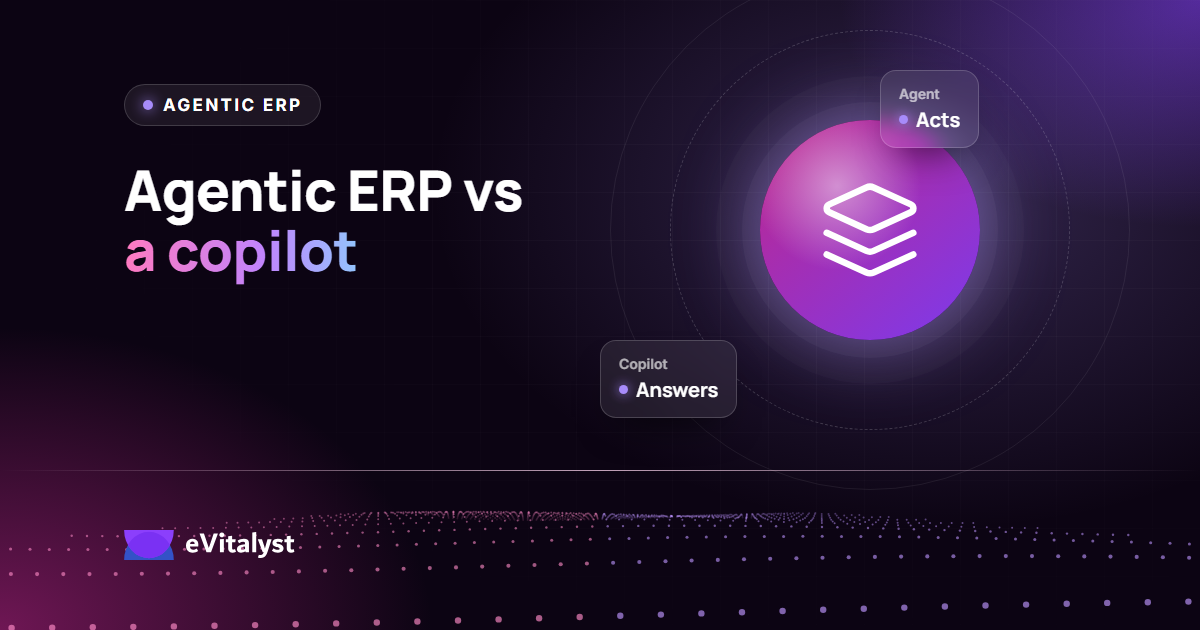
- A copilot helps a person use the ERP; an agent does part of the work inside it.
- The value of agents comes from acting through the ERP’s own rules, with approvals.
- Most companies need both: answers for everyone, agents for selected processes.
Almost every ERP vendor now offers an AI assistant. Not all of them are agentic, and the difference matters when you decide what to buy and what results to expect.
The copilot: help for the person
A copilot sits beside the user. It answers questions, explains screens, summarises records and suggests what to type. The user still does the work: opens the document, enters the data, runs the process. It saves time per task, but the number of tasks people do stays the same.
The agent: work done inside the system
An agent is given a goal and the permission to pursue it. An MRP agent does not explain the material plan; it prepares the purchase requisitions for the shortages it finds. An invoice agent does not describe the three-way match; it holds the invoice whose quantity does not match the goods receipt and routes it to the buyer. People review and approve, but they no longer prepare.
Side by side
| Copilot | Agentic ERP | |
|---|---|---|
| Who does the work | The user, faster | The agent prepares; the user approves |
| Data entry | Suggestions while typing | Drafts from documents and descriptions |
| Exceptions | Found if someone asks | Raised as they happen |
| Planning | Explains the output | Proposes the plan and the purchases |
| Learning | Starts from zero each time | Remembers context and results |
Why acting is harder, and why it matters
Answering is low-risk: a wrong answer can be questioned. Acting in a ledger is not. That is why agentic ERP needs a different architecture: agents must act through the same services, validations and workflows as people, create drafts before anything is posted, and leave an audit trail. Our page on architecture and governance explains how eVitalyst does this.
What to ask a vendor
- Which tasks does the AI complete, not just explain?
- Does it act through business rules and approvals, or around them?
- Can it remember earlier questions, and where is that memory stored?
- How do you measure whether an agent is ready for more autonomy?
For the full comparison including traditional ERP, see agentic ERP vs traditional ERP.
Want the full picture? Download the agentic ERP white paper for leadership teamsor see eVitalyst AI on your own data.